What is a boundary trap, and why does it keep blocking?
The capped pipe near your front boundary is a water seal between your house and the sewer, and it is often the first place an older North Shore line blocks.

A boundary trap is a water-filled bend in your sewer line near the property boundary that stops sewer gas coming back into the house. Its bend is a common place for roots, wipes and fat to collect, so it often blocks first. On a house, it is part of the private line, which makes it the owner’s responsibility.
Key takeaways
- A boundary trap is a buried water seal near your boundary that keeps sewer gas out of the house.
- Look for a round cap at ground level and a short vent pipe near the front or rear boundary.
- A blocked trap slows every fixture at once, and water in the riser when you lift the cap points to a blockage at or past the trap.
- On a house the trap is the owner’s responsibility, and so are roots entering the junction at the point of connection.
- Most blockages clear through the riser, but a camera run is what shows whether the pipe needs repair.
Jump to a section8
What a boundary trap is
A boundary trap is a fitting buried in your sewer line near the point where your private pipes join the public sewer, usually close to the front or rear boundary of the block. Sydney Water’s guide to reading a sewer service diagram describes it as a fitting below the ground at your connection to its wastewater system that stops gases entering your pipes.
It works the same way as the trap under a sink. The pipe dips into a bend that always holds a little water, and that water seal sits between your house drain and the sewer main. Air from the main cannot push past it, so the smell stays in the street.
The parts you can actually see
Most of a boundary trap is underground. What gives it away above ground is usually one or more of these:
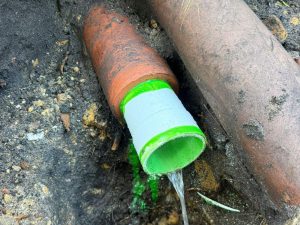
- A capped riser: a round cap at ground level, often in a lawn, garden bed or the side path, which is the access point straight down to the trap.
- A vent pipe with a flap: a short pipe near the boundary with air vents. Sydney Water calls this an induct pipe with a mica flap, and it lets air into your pipes.
- An inspection shaft: on some properties the access point near the connection is a shaft rather than a trap riser. Sydney Water describes it as an access point your plumber uses to check or unblock the pipes.
If you cannot find anything, it may be buried under paving, a garden bed or turf laid over it years ago. That is common, and it is worth finding before you need it.
Why boundary traps turn up in older North Shore homes
A lot of the North Shore’s housing went up long before plastic pipe, and many of those older sewer connections still run through earthenware. Boundary traps belong to that generation of plumbing, which is why they come up so often on older blocks in Ku-ring-gai, Willoughby and North Sydney.
Not every property has one. Whether yours has a trap, an inspection shaft or a plain connection depends on when it was connected and what has been done to the line since, so it is worth checking rather than assuming.
How to find out what your property has
- Look for the cap and the vent near the front or rear boundary, in line with where the sewer leaves the house.
- Buy the sewer service diagram. Sydney Water sells them through its Tap in service, and its diagrams and prints page notes that older diagrams show the point of connection to its wastewater system. A boundary trap has its own symbol.
- Get it confirmed on camera. A diagram shows what was approved, not what is in the ground today. A camera run shows what is actually there.

Why a boundary trap blocks
The water seal that makes a boundary trap useful is also what makes it the most likely place on the line to block. Everything leaving the house has to climb out of that bend, so anything heavy or stringy tends to settle there first.
The four usual causes
- Tree roots. Older earthenware joints around the trap let in moisture, and roots follow it. Under the North Shore’s established canopy, roots are one of the most common causes.
- Wipes and sanitary items. Products sold as flushable do not break down the way toilet paper does, and they catch in the bend.
- Fat and grease from the kitchen, which cools and sets inside the pipe.
- A broken or missing riser cap. Soil, leaves and garden debris fall straight into the trap from above.
The signs that point to the boundary trap
A blockage at the trap affects the whole house, not one fixture, because every drain passes through it. Watch for:
- Several fixtures draining slowly at once, often worst at the lowest one.
- Gurgling from the toilet or shower when another fixture empties.
- Water rising in the overflow relief gully outside, or spilling from it.
- Water sitting in the boundary trap riser when you lift the cap.
That last check is useful. If the riser is full, the blockage is at or past the trap. If it is empty while the house drains back up, the problem is between the house and the trap.

Want this looked at rather than guessed at? Voyager agrees a fixed price before the work starts, and there is no callout fee on eligible jobs.
Call 0485 028 787 or read more about sewer repairs on the North Shore.
Who is responsible for the boundary trap
On a house connected to Sydney Water’s network, the boundary trap is almost always part of the private line, which makes it the owner’s responsibility. Sydney Water’s guidance on maintaining your service says property owners look after their wastewater pipes up to where they connect to its system, and that while Sydney Water owns the junction, the owner is responsible for the connection to it.
The same page puts tree roots on the owner as well: the owner clears roots that enter the junction at the point of connection, and pays for damage to the junction caused by roots or excavation.
| Part of the line | Who looks after it | What that means in practice |
|---|---|---|
| House drain and fixtures | Property owner | Any blockage or repair is yours to arrange |
| Boundary trap, riser and vent | Property owner | Clearing it, replacing a cap or repairing it is private plumbing work |
| Connection to the junction | Property owner | Including roots that enter the junction at the connection |
| Junction on the sewer main | Sydney Water owns it | Damage caused by roots or excavation is still charged to the owner |
| Sewer main | Sydney Water | Report a main blockage to Sydney Water directly |
Strata buildings work the same way at the property line, with the owners corporation in place of a single owner for the common property drainage.
Do you still need a boundary trap?
For commercial properties the answer is clear. Sydney Water’s grease trap installation requirements say there must be a boundary trap on all commercial and industrial properties with a gravity connection to the sewer, and one has to be installed if it is missing when a trade waste permit is applied for.
For houses it depends on the property, and it is not a decision to make with a shovel. Removing or bypassing a trap changes how the connection to the sewer works, and the work has to be done by a licensed plumber and drainer. The right question to ask is what Sydney Water’s requirements say for your connection, not whether the trap can come out.
Where a reflux valve comes into it
On properties where the sewer can back up, a reflux valve may be fitted to stop it reaching the house. Building Commission NSW’s reflux valve requirements (Note 2/2026, June 2026) say that where a surcharge is likely, the valve is installed immediately downstream of the boundary trap or inspection shaft. That is one more reason to know which of the two your property has before any work starts.
How a blocked boundary trap gets cleared and repaired
Most boundary trap blockages clear from the riser without digging anything up. The usual order of work:
- Clear the blockage through the riser, by jetting or with a root cutter if roots are the cause.
- Run a camera through the trap and the line either side of it, so you know whether it blocked because of something flushed or because the pipe is damaged. A camera inspection of the sewer line is what tells those two apart.
- Fix what the camera finds. A cracked trap, a root-filled joint or a collapsed section needs repair, or the blockage comes back.
- Replace a missing or broken cap so garden debris stops falling in.
Repair or replace
Where the trap itself is cracked or broken, it is usually dug out and replaced. Where the damage is in the pipe either side, relining can sometimes seal it without a trench. If you are weighing that up, we can repair or replace the sewer line and tell you which option suits the damage we actually find.
Digging on the North Shore has an extra step worth knowing about. Ku-ring-gai Council’s development control plan counts changing ground levels in a tree’s root zone by excavation, and severing roots of 50mm or more, as injuring a protected tree, which is prohibited without the council’s written consent unless an exemption applies. A boundary trap sitting under a big street-side tree can mean an application before the excavator turns up.
| Job | Indicative range across Sydney |
|---|---|
| Clearing a blocked main sewer line | $300 to $600 |
| High pressure jetting | $250 to $600 |
| Root cutting | $400 to $1,200 |
| CCTV drain inspection | $250 to $550 |
| Pipe relining, 100mm, per metre (Voyager’s rate) | $450 to $800 |
These are indicative ranges to judge a quote against, not a quote. Access, depth and what the camera finds all move the price.

Looking after a boundary trap
A few habits keep a boundary trap working for decades:
- Keep the cap visible and intact. Do not pave, turf or garden over it. A plumber who has to hunt for the riser is a plumber charging for the hunt.
- Keep the vent clear of garden beds and stacked items so air can move.
- Only flush the three Ps: pee, poo and toilet paper. Wipes go in the bin.
- Bin fat and grease rather than pouring it down the sink.
- Act on the first slow drain. A partial blockage at the trap is a cheap clear. A full one can mean wastewater coming up through the lowest drain in the house.
If drains are backing up right now, our team handles unblocking drains across the North Shore, and you can ring us any time.
Not sure what your line looks like? Ask the plumbing team on the North Shore to find the trap and camera the line, and you will know where you stand before anything goes wrong.
Frequently asked questions
Where is my boundary trap?
Usually near the front or rear boundary, in line with where the sewer leaves the house. Look for a round cap at ground level and a short vent pipe nearby. Sydney Water’s sewer service diagram for the property marks it with its own symbol, and a camera inspection confirms what is actually in the ground.
Is the boundary trap my responsibility or Sydney Water's?
On a house it is part of the private line, so it is the owner’s. Sydney Water says owners maintain their wastewater pipes up to where they connect to its system, and are responsible for roots entering the junction at the point of connection, even though Sydney Water owns the junction itself.
Can I take the cap off my boundary trap?
Yes, to look. If the riser is full of water, the blockage is at or past the trap. Do not push anything down it or try to clear it yourself, and put the cap back properly afterwards so debris cannot fall in.
Can a boundary trap be removed?
Commercial and industrial properties with a gravity connection must have one under Sydney Water’s requirements. For a house, whether it can change depends on Sydney Water’s requirements for that connection, and the work must be done by a licensed plumber and drainer. Ask before anyone starts digging.
Why does my boundary trap smell?
A sewer smell near the boundary often means the water seal has been lost, the cap is broken or missing, or the vent is damaged. Any of those lets gas from the main escape into the yard, so it is worth having the trap checked.
In short
A boundary trap is a water seal near your boundary that keeps sewer gas out of the house, and its bend is where roots, wipes and fat tend to collect. On a house it is the owner’s responsibility. Keep the cap visible and intact, act on the first slow drain, and get a camera run so you know whether a blockage is a one-off or a damaged pipe.
Need a licensed North Shore plumber?
Free quote, a fixed price agreed before the work starts, and someone on the end of the phone at any hour. No callout fee on eligible jobs, subject to current terms.
Call 0485 028 787Get a free quote
NSW Contractor Licence 476657C · fully insured · 24/7
Share this guide
Read it with an AI assistant
Mathew is a licensed plumber, drainer and gasfitter, and the owner of Voyager Plumbing. He has held his own NSW contractor licence since December 2016 and is the nominated supervisor on the company licence.
Voyager Plumbing works across Sydney’s North Shore. NSW Contractor Licence 476657C, fully insured, available 24/7.
Sources
- Sydney Water, Help with your sewer service diagram (PDF)
- Sydney Water, Maintaining your service
- Sydney Water, Diagrams and prints
- Sydney Water, Grease traps installation requirements (PDF)
- Building Commission NSW, Reflux valves requirements (Note 2/2026)
- Ku-ring-gai Development Control Plan, Part 13 Tree and Vegetation Preservation (PDF)